

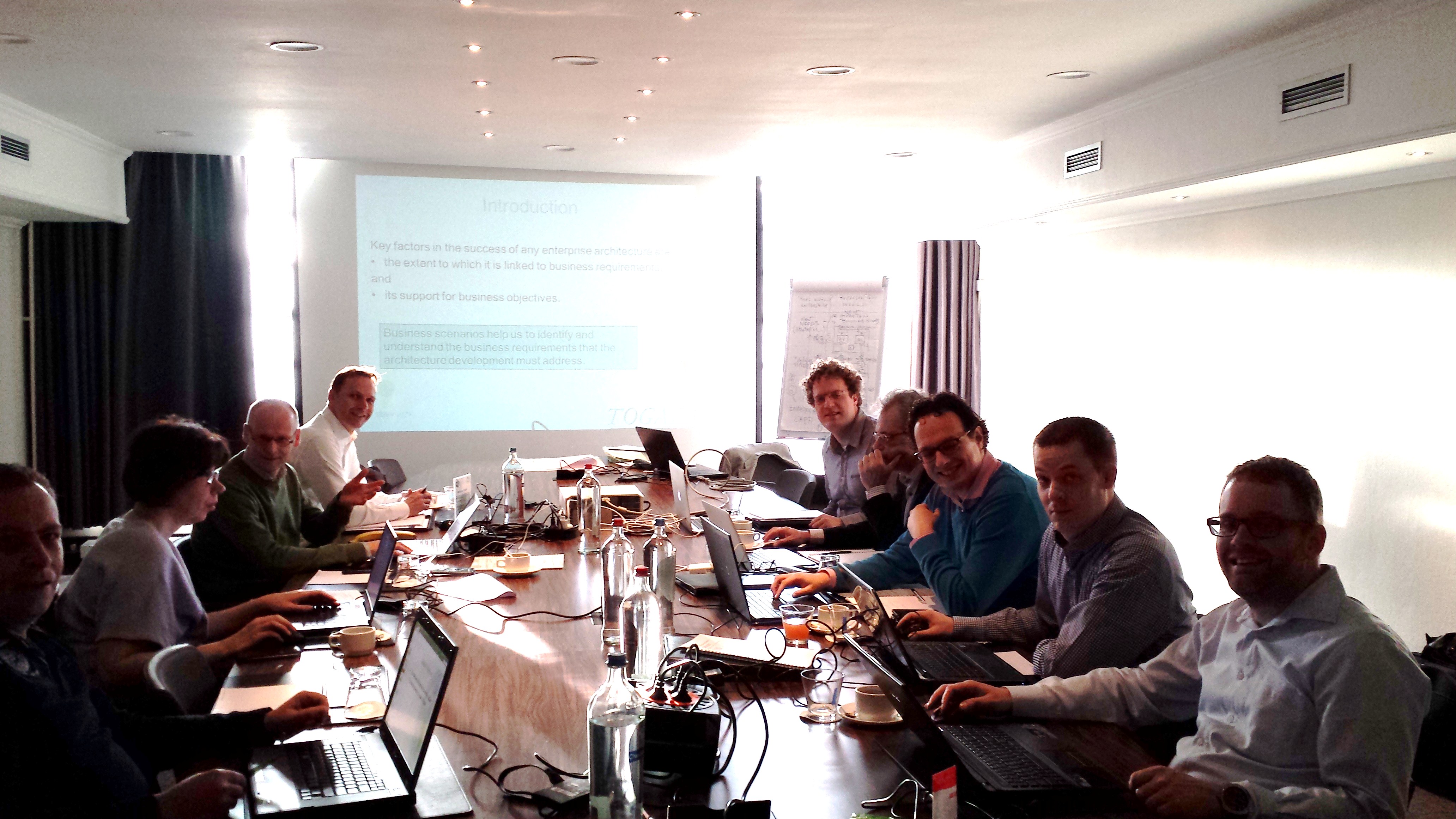
GooBiz is a consultancy and training company providing Agile / Digital Transformation & System Engineering services across NA, EMEA (and currenty all other locations including Asia-Pacific in distance training and consultancy)
Recommendations from our customers
We actively contribute to the works on the usage of the OMG's UAF, SySML, BPMN as well as the NATO NAF v4 and Open Group's O-AA, TOGAF and ArchiMate standards. Our training modules cover Enterprise and System Architectures until their implementation through which we help our customers to understand how to efficiently use these standards.
 In addition to our training and mentoring services on the applications of these standards, we help you to customise them to align your organisation and IT structures with digital disruption.
Such a data-driven alignment allows you to bring regular improvement to your processes and confers a competitive reactivity to your organisation.
Contact mail : birol.berkem@goobiz.com
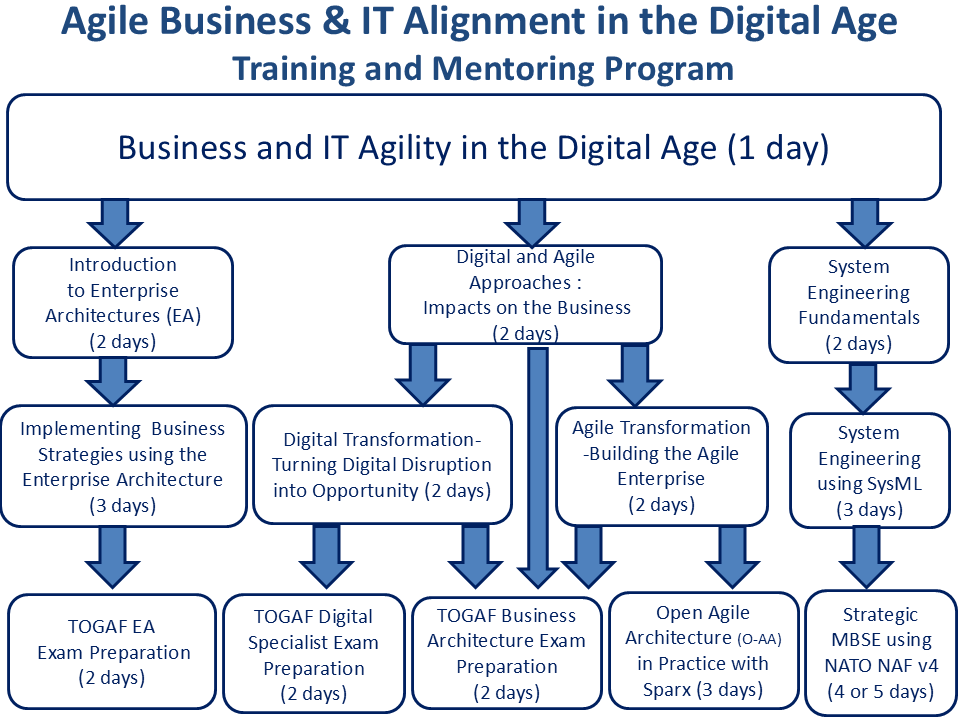
Training & Mentoring Program for 'Agile Enterprise and System Architectures in the Digital Age'
Agile Business and IT Alignment based on Digital Business Modeling, Enterprise Architecture and Agile Development standards
Companies facing the Digital Age need to align their Business and IT Systems more proactively than ever before due to competitive pressure caused by digital disruptions.
The following modular program aims at presenting training elements to assist you in turning technology disruptions into business opportunities by ensuring synergies between frameworks such as Digital Business Models, Business and Enterprise Architectures, Agile Methodologies and relevant requirement management and Modeling standards.
Arrows indicate below the order in which these modules should ideally be taken up by the attendees.
However this also depends on your profile and aspirations. For example, the modules that figure in the bottom part of the three can be attended separately.
One of our latest testimonials - others are available here
Business and IT Agility in the Digital Age (1 day)
Objective : This introduction seminar provides you with an overview of the digital business models, business and enterprise architecture frameworks as well as methodologies that are used by the organizations to increase their agility facing the digital age disruptions.
In particular, this seminar aims at helping you to understand frameworks that are used worldwide to align digital business models, organization and IT architectures with changing competitive landscape (Click for details).
Prerequisites : None
Attendees Profiles : CxO, Operation Managers, Enterprise Architects, Business Analysts.
EA and MBSE : UAF 1.1 in the Context of NATO NAF v4 Framework (3 days extendible to 4 days with Cameo hands-on)
Objective : This course aims at helping attendees understand how to put in practice the UAF and NAF architecture frameworks to align their organization and resources based on changing strategies.
Concepts and techniques explained during the course are progressively applied by the attendees using an end-to-end case study and different exercises on it.
Prerequisites : Knowledge in Modeling with UML or SysML is beneficial but not required
Participant Profiles : Strategists, Asset Managers, Enterprise Architects, System Architects, Business Analysts, System Analysts, Software Designers (Click for details).
Introduction to Enterprise Architectures (2 days)
Objective : This training course aims at helping attendees understand the most used Enterprise Architecture Frameworks and rules to follow up in their construction to succeed with an appropriate architecture scenario for their organization.
Thanks to the selection of appropriate architecture layers, components and traceability links that are to be established from the business to the technical architecture layer, the resulting enterprise architecture framework allows you with a good impact analysis in face of evolutions of the business decisions and anticipate mutations of the corresponding information system components (Click for details).
Prerequisites : None
Attendees Profiles : Business Strategists, Enterprise Architects, Business Architects, System Architects, Business Analysts, System Analysts, Software Designers.
Implementing Business Strategies using the Enterprise Architecture (3 days)
Objective : This training course aims at helping attendees understand concepts and principles of the Business Motivation Model (BMM) to meet the business goals and strategies of the companies and establish the bridge to the Enterprise Architecture Framework in order to implement them in coherence.
Concepts explained during the course are reinforced by examples and case study illustrations (Click for details).
Prerequisites : None
Attendees Profiles : Business Strategists, Enterprise Architects, Business Architects, System Architects, Business Analysts, System Analysts, Software Designers.
Putting the Enterprise Architecture into Practice (3 days for TOGAF Certified Architects or practitioners who have already acquired necessary knowledge of this Certification)
Objective : This course aims at helping attendees understand how to implement TOGAF 9.1 in practice to meet the enterprise business goals and strategies.
Concepts and techniques provided during the course are progressively applied by the attendees using a case study and different exercices on it (Click for details).
Prerequisites : Previous experience in Enterprise Architectures or at least having already acquired ccncepts of TOGAF
Attendees Profiles : Enterprise Architects, System Architects, Business Analysts, System Analysts, Software Designers.
Digital Transformation - Impacts on the Business (2 days)
Objective : Helping attendees to identify new usage of the 'digital technologies' and new behaviours of stakeholders induced by the digital technology evolutions. The content of this course also allows them to determine impacts and benefits of the digitalization process for different entities of their enterprise as well as its impacts on the IT (Click for details).
Prerequisites : None
Attendees Profiles : CxO, Business Strategists, Enterprise Architects, Business Architects, System Architects, Business Analysts, System Analysts.
Digital Transformation - Guiding the Big Data to Strengthen the Decision-Making (3 days)
Objective : This training aims at helping attendees (CxOs, business strategists, business analysts, product managers and architects) understand foundations of the Digital Business Models, their connections with the Enterprise Architectures and Value Propositions in order to efficiently integrate "digital value creation and value delivery" from strategies to the implementation of appropriate products and services.
Attendees will learn in this course how to adapt strategies to digital disruptions, assess impacts on the Value Chain, Framing and Channeling the Big Data to strengthen the Decision Making to create differentiating products and services (value propositions) and adjust such value propositions to digital consumer decision journey (Click for details).
Prerequisites : None
Attendees Profiles : Business Strategists, Enterprise Architects, Business Architects, System Architects, Business Analysts, System Analysts, Software Designers.
Big Data and its Management Process (2 days)
Objective : This training course aims at helping attendees understand why Big Data is changing our lives and how it is altering the way businesses see us as consumers. Indeed, users of big data in businesses find that big data unleashes a wealth of information and insights which translate to higher profits, reduced costs, and less risk. However, the downside was frustration sometimes when putting too much emphasis on individual technologies and not enough focus on the pillars of big data management.
Attendees will learn during this course how to manage the big data using its three pillars of data integration, data governance and data security in order to turn big data into real business value. Different exercices conducted on a case study of customer management will help attendees to better understand the underlying processes (Click for details).
Prerequisites : None
Attendees Profiles : Business Strategists, Enterprise Architects, Business Architects, System Architects, Business Analysts, System Analysts.
Business Modeling for an Agile Digital Alignment (2 days)
Objective : Helping attendees understand how to efficiently model and validate their business processes and organization assets in order to increase business agility of their organization on the basis of their target architecture and changing digital market needs.
This 2 day training course aims at helping delegates to learn how to model their business processes and assets in order to adapt them to digital disruptions based on goals, strategies and impacted capabilities as part of the target architecture. On the basis of the of key elements of business performance (strategies, tactics, KPI, business capabilities, etc...), delegates learn there how to elaborate a digital vision centric business process and asset cartography. Then, only using the appropriate BPMN and UML notation adapted to their language, they understand how to adapt processes to changing strategies, policies and digital consumer day (Click for details).
Prerequisites : None
Attendees Profiles : Business Strategists, Enterprise Architects, Business Architects, System Architects, Business Analysts, System Analysts.
Business Process Modeling (BPM) using BPMN and UML (2 days)
Objective : This training course aims at helping business analysts learn to model efficiently their business processes using BPMN as well as resources that are handled by their activities. Being conducted by an agile entreprise framework, business analysts learn during this course how to use appropriate BPMN notations and business extensions of UML in order to deal with their "business requirements" and coherently drive underlying design level activities (Click for details).
Prerequisites : None
Attendees Profiles : Business Architects, System Architects, Business Analysts, System Analysts, Software Developers.
Value-Driven Requirement Management for Agile Methods (3 days)
Objective : This training course aims at helping product managers, products owners, business analysts, system architects and developers understand how to efficiently Manage Requirements on the basis of the product vision till guiding developers accurately in implementing them.
More in detail, this course aims at assisting product managers in better defining the value propositions of their products on the basis of strategies and stakeholder needs. Business Analysts and product owners understand how to describe requirements of the product backlog then discover appropriate epics and user stories of the system while contributing to the required value creation. Along interactive case study exercises, participants learn how to describe in detail such requirements in order to validate correct understanding of needs and prepare system acceptance tests. Thus, only using a very common and productive UML profile, they learn to structure requirements in order to communicate efficiently with architects and developers through an iterative requirement gathering process (Click for details).
Prerequisites : None
Attendees Profiles : Business Strategists, Enterprise Architects, Business Architects, System Architects, Business Analysts, System Analysts.
Business and Enterprise Architecture Patterns (2 days)
Objective : Helping Business and Enterprise Architects understand patterns to ensure coherent evolution and traceability from strategies until the implementation of corresponding operating entreprise models.
These patterns aim at analyzing impacts of disruptions on the Value Chain, then assign underlying business capabilities with relevant responsibilities until guiding adaptation of the "value propositions". Finally, they allow fine-tuning value propositions to relieve pains based on digital consumer experience and provide them with expected and unexpected gains through stages of value streams.
An end-to-end case study also allows attendees to make use of these "guidelines" in order to establish traceability from business strategies till operating model elements of the EA (Detailed Description will be available soon).
Analysis and Design Patterns (2 days)
Objective : Helping Analysts and Designers understand how to go through software implementation of the requirements, ensuring traceability between business specifications and the software code.
This 2 day training course aims at assisting technical analysts and designers in designing specifications described by the business analysts. After transformation into software component representations, the resulting system components trace system requirements toward software component structures.
Finally, these technical specifications are implemented in software code and tested upon component basis. The resulting software components provide good level of reactivity to changes as they allow to trace separately toward the implementation level the system behaviors layer by layer (from the user interfaces toward business objects layer through application components where usage choices of the actors are stored (Click for details)
Prerequisites : Previous experience in Software Development using Object Oriented Languages or at least using structural languages like the "C language"
Attendees Profiles : System Architects, System Analysts, Software Developers
Designing SOA using BPM and SoaML (3 days)
Objective : Helping analysts, architects and designers understand how to efficiently specify and realize a Service Oriented Architecture on the basis of their business goals and align it to changing business and user requirements.
This 3 day training course aims at helping business analysts, architects and designers learn how to specify and realize a featured Service Oriented Architecture to better deal with changes on the business and user requirements (changing objectives, strategies, tactics, rules, user interactions,...) while capitalizing on the business capabilities (Click for details).
Prerequisites : Previous experience in Business Modeling or at least having already acquired ccncepts of the "Business Modeling" in a digital or a non-digital environment.
Attendees Profiles : Business Architects, System Architects, Business Analysts, System Analysts.
System Engineering (SE) Fundamentals and Architecture Frameworks (3 days)
Objective : Providing attendees with an overview upon the System Engineering and helping them understanding its fundamentals.
This 3 day training course aims at helping engineers acquire a common terminology of the SE discipline, to understand the system vision, principles and processes on the basis of standards like ISO/IEC 15288 and ISO/IEC/IEEE 42010 as well as architecture frameworks used in the domain of System Engineering (TOGAF, DoDAF, MoDAF, ...) (Click for details).
Prerequisites : None
Attendees Profiles :
Any actor involved in the System Engineering domain : System Architects, System Analysts, System Engineers, Managers having the responsibility to let all SE actors adhere to a corporate approach, Engineers with one or more experience(s) in multidisciplinary system areas.
System Engineering using SysML and UML 2 (3 days)
Objective : Helping analysts and designers of the System Engineering domain understand how to efficiently gather requirements then go through the embedded software design and implementation on the basis of system specifications using UML 2 and SysML.
This 3 days training aims at assisting system analysts to express efficiently their needs and designers to make the appropriate architectural design of the system on the basis of these needs.
The resulting system architecture provides a good level of agility to the embedded system software in face of changes as it allows a coherent traceability of the business rules encapsulated in system functions and those of the usage choices (use cases) of the end-users toward the software implementation level (Click for details).
Prerequisites : Previous experience in System Engineering or at least having already acquired ccncepts of the "System Engineering Fundamentals" course
Attendees Profiles : Any actor involved in the System Engineering domain : System Architects, System Analysts, System Engineers, Managers having the responsibility to let all SE actors adhere to a corporate approach, Engineers with one or more experience(s) in multidisciplinary system areas.
The logos UML, SysML, MDA referenced on this site are trademarks of the Object Management Group (OMG).
The RUP is a trademark of the IBM / Rational.
TOGAF/ArchiMate and Zachman are respectively trademarks of the Open Group and Zachman International