


Data-Driven Digital Transformation : Patterns for Data-Driven Strategic Value Delivery
A Data-Driven Strategic Digital Transformation Framework to deliver VALUES and adjust them according to Consumer Feedbacks in coherence with 'DESIRED EFFECTS' to accomplish...
As the pace of digital disruption is dramatically continuing to increase, companies need more than ever acquire Decision-Making tools to adapt rapidly and cost efficiently their organization governance, products and services in response to changes and adjust them to changing needs of consumers.
A swift and coherent adaptation to changes at all levels in the enterprise requires alignment of clusters of data with focus on “value-driven data points” based on Goals and delivery of appropriate Values to avoid wastes with a rise of "non valued data" in data collection and diffusion processes.
To align the "data collection" process with high-level goals and strategies then "route the collected 'insightfull information' to the right actors" for decision-making while supporting appropriate value delivery to clients based on their feedbacks, traceability chains from goals and strategies until business processes and roles that 'handle the data' need to be configured based on a "Data-Driven Value Delivery Approach".
In order to ensure such a coherence within the surrounding business environment while re-adjusting goals and underlying elements of the architecture based on consumer feedbacks, the architecture elements from goals till operational data flows shall be assigned with appropriate responsibilities aligned with these high-level goals.
The goal-driven assignment of responsibilities requires to operate on identifiable and reconfigurable architecture elements (from high-level goals up to operational data and insight that need to be routed to the right processes and roles) to deliver desired values.
To be identifiable and flexible against changes, architecture elements need to be expressed each by specifying the entity that is to be monitored (competitors, regulations, technology,..., consumers ) upon which a desired effect need to be realized, the means that have to be used or deployed to reach this desired state and the Value that needs to be delivered.
A network of architecture elements where elements are formatted using such a formulation helps not only to closely align bottom-line structures of the architecture based on high-level goals and strategies ; but it does also help in adjusting strategic elements of the architecture based on 'actionable insights' derived from "data" elements captured at the operational level. Such insights can be 'considered as new Means' in realizing these desired effects.
The figure below depicts an initial compact representation of the 'Data-Driven and Goal-Based Value Delivery Approach". Its steps are enabled by dedicated architecture patterns (see below).
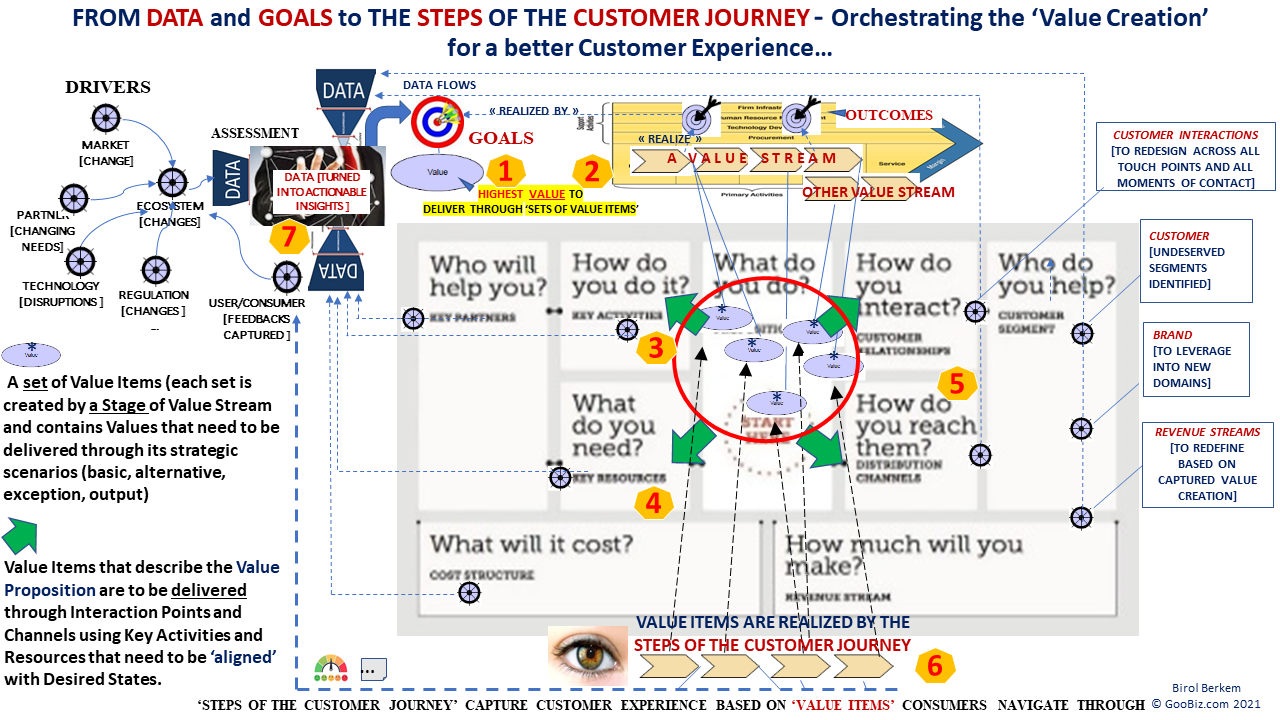
Figure 1 : Steps in the Value Creation and Delivery Cycle from "Goals to the Customer Journey" then back to the Assessment of Feedbacks for Decision-Making
The Steps of the Value Creation and Delivery Cycle from "Goals to the Customer Journey" up to the Assessment of Feedbacks for Decision-Making are as follows :
* Step 1 - Set Goals, Outcomes and the Highest Values to deliver through the Stages of Value Streams,
* Step 2 - Describe Value Stages that realize Courses of Actions and Value Items that need to be delivered by Strategic Scenarios,
* Steps 3 and 4 - Configure Capabilities, Processes and Data Flows to ensure "Data" getting routed where needed according to Strategic Scenarios of a Value Stage then 'Services' to guide the collection and transformation of Data as part of "Resources",
* Step 5 - Describe Customer Interactions to plan 'Delivery of Values' across all touch points and all moments of contact where "Completeness" of strategic scenarios of each Value Stage need to be ensured to consider all potential Customer behaviours,
* Step 6 - Capture feedbacks from Consumers and IoT Devices (Performance Data) through the 'Steps of the Customer Journey',
* Step 7 - Assist the decision-making by adjusting Goals and Strategies based on Real Consumer Experience captured through Steps of Customer Journey vs. Values Planned to be delivered via Strategic Value Items
PATTERNS OF THE "GOAL AND DATA-DRIVEN TRANSFORMATION" for an ALIGNED VALUE DELIVERY
Two groups of architecture patterns come to underpin the steps of the Data-Driven and Goal-based Transformation focusing on the Value Delivery.
Group 1 : Patterns to "Align Organizations with their Strategies" and "Get the Data Routed where needed"
•In order to develop required capabilities in reaching the desired effect on a monitored entity, redesign interactions with consumers across all touch points and all moments of contact then align underlying Operational Structures of the Organization by assigning them contextual Roles and responsibilities, "Completeness and Traceability of Strategic Scenarios need to be ensured (b- Pattern STC).
Finally « the right Data needs to be routed to the right Roles » according to high-level goals, values, strategies and required interactions with stakeholders. This is supported by (c- Pattern RDV).
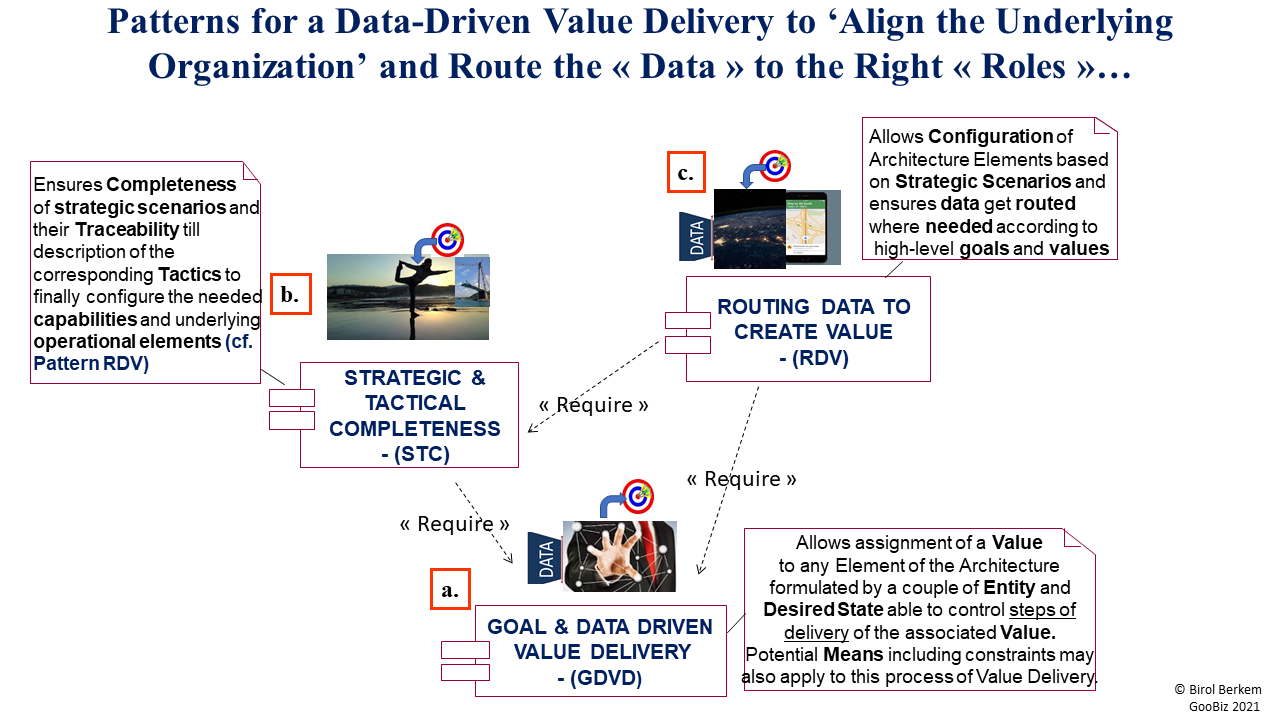
Figure 2 : Patterns for Aligning the Operational Elements of the Organization (Roles, Functions, Processes,...) with high-level goals and Routing the Right Data to the Right Roles...
Group 2 : Patterns to ensure a 'Coherent Decision-Making and Cohesive Evolution' through Strategic Revisions
This second group of Patterns aims at utilizing the Architecture Structure resulting from the application of the previous group of Patterns to ensure a Coherent Decision-Making and Evolution based on « Data and Insights »
Figure 3 : Patterns for a Coherent Decision-Making and Evolution based on the Customer Journey
Notice about the Dependency Relationships 'Require' directed from any Pattern P2 (source) to Pattern P1 (target):
The dependency relationship « Require » directed from a Pattern P2 (source) to Pattern P1 (target) indicates that P2 needs to use 'services offered' by the pattern P1 as a prerequisite.
Pattern Enabled Value Delivery : "Formulating Architecture Elements that directly 'contribute to Value Creation'
The commonality of the steps' referenced in figure 1 for a Data & Goal-Driven Value Delivery is that the underlying architecture elements (from goals to... data flows) must directly contribute to value creation. As a consequence, these elements need to be individually identifiable and flexible against changes then be actionable in order to align all of the underlying elements in a cohesive reaction to change.
In this perspective, such elements of the architecture that directly contribute to value creation are expressed as 'Entities' with 'Desired States' to be able to 'host' the 'Value to Deliver' within their 'context'.
In addition, to become "Identifiable" and "Flexible" against changes then be "Actionable" to align underlying elements of the architecture in delivering personalized Values to consumers depending on the context, the architecture elements cited above need to be expressed each by specifying :
- the Monitored Entity (Driver) used in the formulation of the Architecture Element,
- the Desired state that should be reached on it,
- Means used as 'constraints' in the realization of the Architecture Element while 'Delivering the Appropriate Value' (Means may correspond to external drivers such as changes captured in technology and business environment such as regulations or internal drivers such as "data elements" collected as feedbacks from consumers).
- Recipient that are external or internal roles to the organization (such as consumers, users or employees) or locations or assets where 'Values' need to be delivered
These meta-data are expressed within the circle in red below to accompany the corresponding Architecture Element which is expressed as a "Goal & Data-Driven Design Element".
For example, the Data-Driven and Goal Based Architecture Design Element'' below reflects any Architecture Element such a "Goal" or "Outcome" in the context of its surrounding elements such as Vision, External Influencer and Feedback Data (on the bottom left) captured from Consumers/Users including those obtained from IoT Equipments (Performance Data).
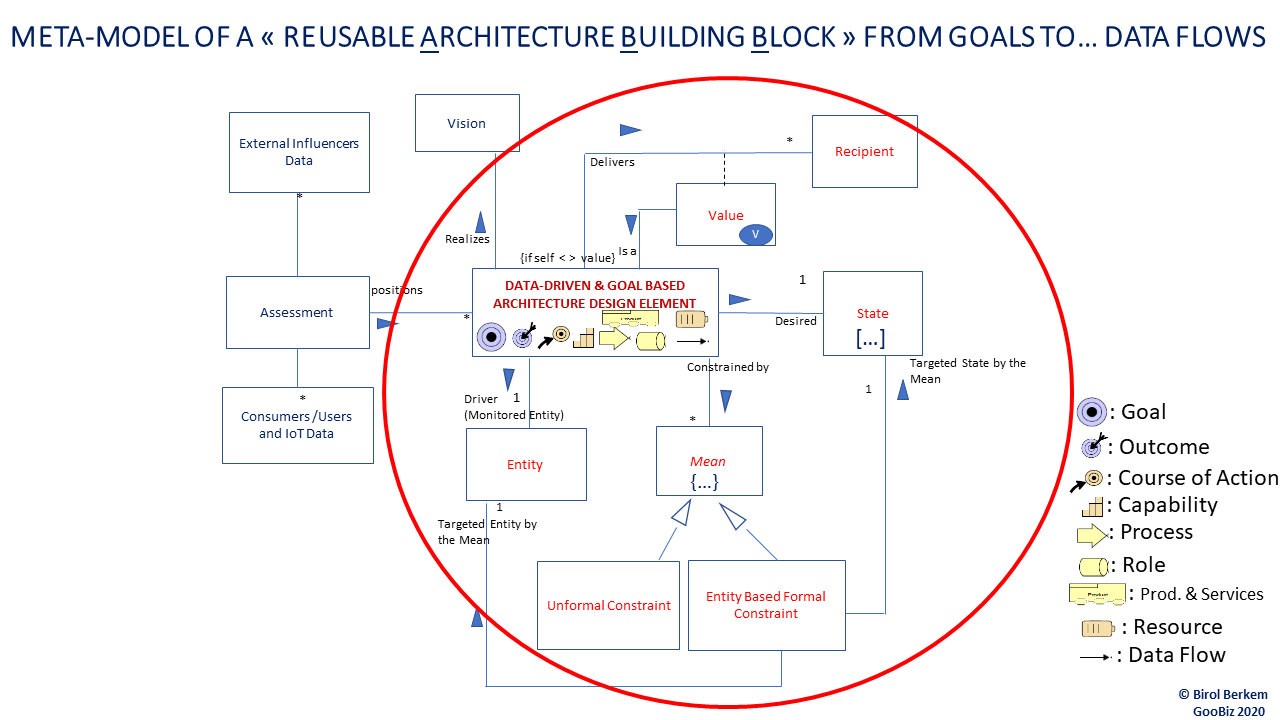
Inside the circle : a 'Reusable Architecture Element' is formulated with its Meta-Data and relationships. Such a formulation of 'architecture elements' directly aims to contribute to the value creation by the organization in reaching its target states.
These elements are Goals, Outcomes, Value Streams, Courses of Actions, Capability Configurations, Services, Processes, Roles and Data Flows that are impacted up-front facing changes and consequently contribute in creating contextual value to recipients such as Clients and Organization.
Among them, the "data flow element" plays two important roles.
In a top-down direction, it allows getting 'data' routed to the right roles based on strategically configured Capabilities and the output Value assigned to be delivered.
In a bottom-up direction, it allows capturing consumer feedbacks through a data entity to help adjust corresponding stategies.
As a summary, the Meta-Data that surround an 'Architecture Element' help to render it :
- "Identifiable under the name of an Entity and a given Desired State",
- "Flexible using appropriate Means depending on the Changes" ,
- "Value Delivering to appropriate Recipients"
- Finally Actionable to align all of the underlying elements based on their States (a top-down alignment).
Example of Top-down Alignment based on Goals
Following an assessment of some external drivers such as the usage of analytics by competitors, the CEO of a WebSale company makes a decision to revise goals in the realization of their Company Vision. In this perspective, a new goal is set to "Turn Visitors into Buyers" using Means such as "Technology tools like Business Analytics and Virtual Reality ".
The underlying architecture elements of that Goal such as Strategies, Capabilities, Processes, etc... are assigned to deliver appropriate contextual decompositions of the high-level Value " Eligible to Benefit from high quality (scored) Complementary Products and Services" to Consumers.
This motivational orientation may be formalized by the following elements :
- the Driver Entity Visitor that is used in the realization of the goal,
- the Desired Effect [Turned into Buyer] that should be reached on it,
- Means (Business or technology ones here) that may be expressed unformally or as 'Entity based Formal Constraints' to be used or deployed : {Business Analytics : Technology} and {Virtual-Reality : Technology},
- Recipients : Consumer, Employee,
- 'Value' that needs to be delivered to Consumers: 'Benefiting from high quality Complementary Products and Services'
- 'Value' that needs to be delivered to Employees: 'Benefiting from Sales based Bonus System'
Example of Bottom-up Alignment using feedbacks captured from Consumers
A network of architecture elements where each element is formatted using such a formulation does not only help to align operational elements on the basis of high-level goals and strategies (a top-down alignment); it does also serve to restructure Strategies of the organization using new Means based on 'feedbacks captured from the operational level and actionable insights' that are derived from such a data (a bottom-up alignment).
In turn, such Means may be expressed using an "Entity and Desired Effect" formulation making them Identifiable with a target state to faciltate their monitoring.
For instance, an assessment of feedbacks captured while consumers are browsing the Catalog of Products may reveal that the Courses of Actions and underlying elements that focus on 'Inciting Visitors to Register' need to be enhanced by new Means like offering 'Free Complementary_Services' and 'Personalized_Offers'.
Such a strategic adjustement may be formalized using the following Meta-Data elements :
- the Driver Entity Visitor used in the realization of the Outcome,
- the Desired state [Incited to Register] that should be reached on it,
- Means expressed as 'Entity based Formal Constraints' like : {Free Complementary_Services [Offered] and Personalized_Offers [Added] } that have to be used or deployed to Incite Visitors to Register,
- Recipients : Consumer, Company
- 'Value' that needs to be delivered to Consumers (Visitors) : "Feeling that the company is listening to them".
- 'Value' that needs to be delivered to Company : "Motivating Visitors to Complete their Registration".
These final contextual values that are planned to be delivered after considering new Means derived from the captured feedback come to support the high-level Value that was expressed by "Benefiting from high quality (scored) Complementary Products and Services" and fairly promised to the client being associated to the highest-level goal.

---
An initial application of these patterns on a case study is provided on : "Data-Driven Digital Transformation : From Goals to Actionable Insights in a Learning Organization"